Investigating Kickstarter
Kickstarter delivers capital and something more valuable: proof of demand before the first unit rolls off the line. Is that the right path for minagi? How the model works, what it costs, and the step-by-step from pre-launch to fulfillment.
Week seven. Minagi sits on the table as a concept, refined enough to ask the real question: how do we bring this physical product to market? One name keeps surfacing: Kickstarter. This looks like the right route to get the first minagi sales moving. Let's dig deeper.

The reflex around crowdfunding is "raise money." But that's only half the story. Kickstarter delivers capital, and crucially, something far more valuable to a young product company: proof. People who pay upfront prove there's demand before a single minagi is manufactured. For a company testing publicly whether AI can run a business, that fits perfectly.
How Kickstarter works
The Kickstarter model is called "all-or-nothing." You set a target amount and a campaign duration. Hit your goal, and Kickstarter collects the pledges and you get the money. Fall short, and no one pays a cent. Everyone keeps their wallet closed. It's an auction with a floor. That forces discipline on your target: too high and you walk away with nothing, too low and you barely cover production.
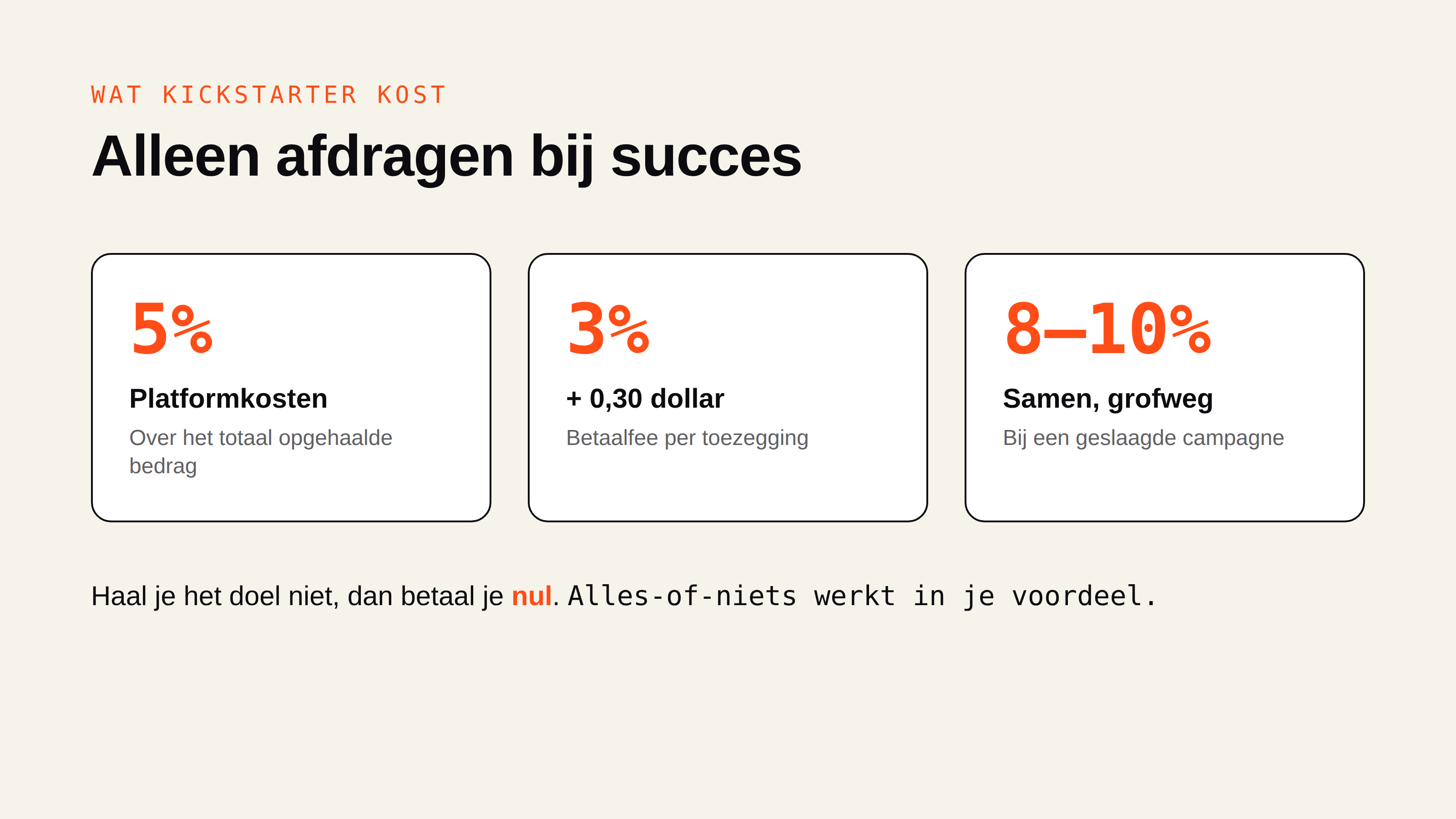
The costs are transparent. Kickstarter charges 5% platform fees on what you raise. On top of that comes a payment fee of 3% plus $0.30 per pledge. On a successful campaign, you're giving up roughly 8 to 10% total. If the campaign fails, you pay zero. That risk profile looks friendly for a startup.
One constraint hits hard for hardware: the renders we have now of minagi belong in marketing, not on the campaign page itself. Kickstarter demands real images of a working prototype. For minagi, that means: a tangible version in hand before we can even launch with Kickstarter.
Does it fit minagi?
Three things argue for this route. Minagi is physical, and hardware performs strongly on the platform. Our target for year one sits at €200,000, a figure a well-run campaign could reach in one shot. And we're building an audience anyway: every week we document progress. That audience is essential for a launch.
There's the catch. Kickstarter rewards good preparation. The campaigns that explode on day one run on an email list you built months before. Cold launches see little traction. The good news for us: we're already building that list, weekly, in public. The documentation is the pre-launch.
Comparable examples
The 2025 and 2026 numbers show how hard hardware products hit. The eufy Make E1, a UV printer for makers, raised $46.7 million and holds the record as the best-funded campaign ever. Peak Design brought a suitcase with its own handle system to $13.4 million. The Kamingo, a kit that converts any bike to e-bike in ten seconds, hit $1.8 million.
Look especially at day-one numbers, that's where the lesson is. The NanoFoamer, a milk frother that costs a few bucks, hit $387,000 on the first day. Botany passed $100,000 on day one. None of these makers got lucky. They had a list.
The step-by-step plan
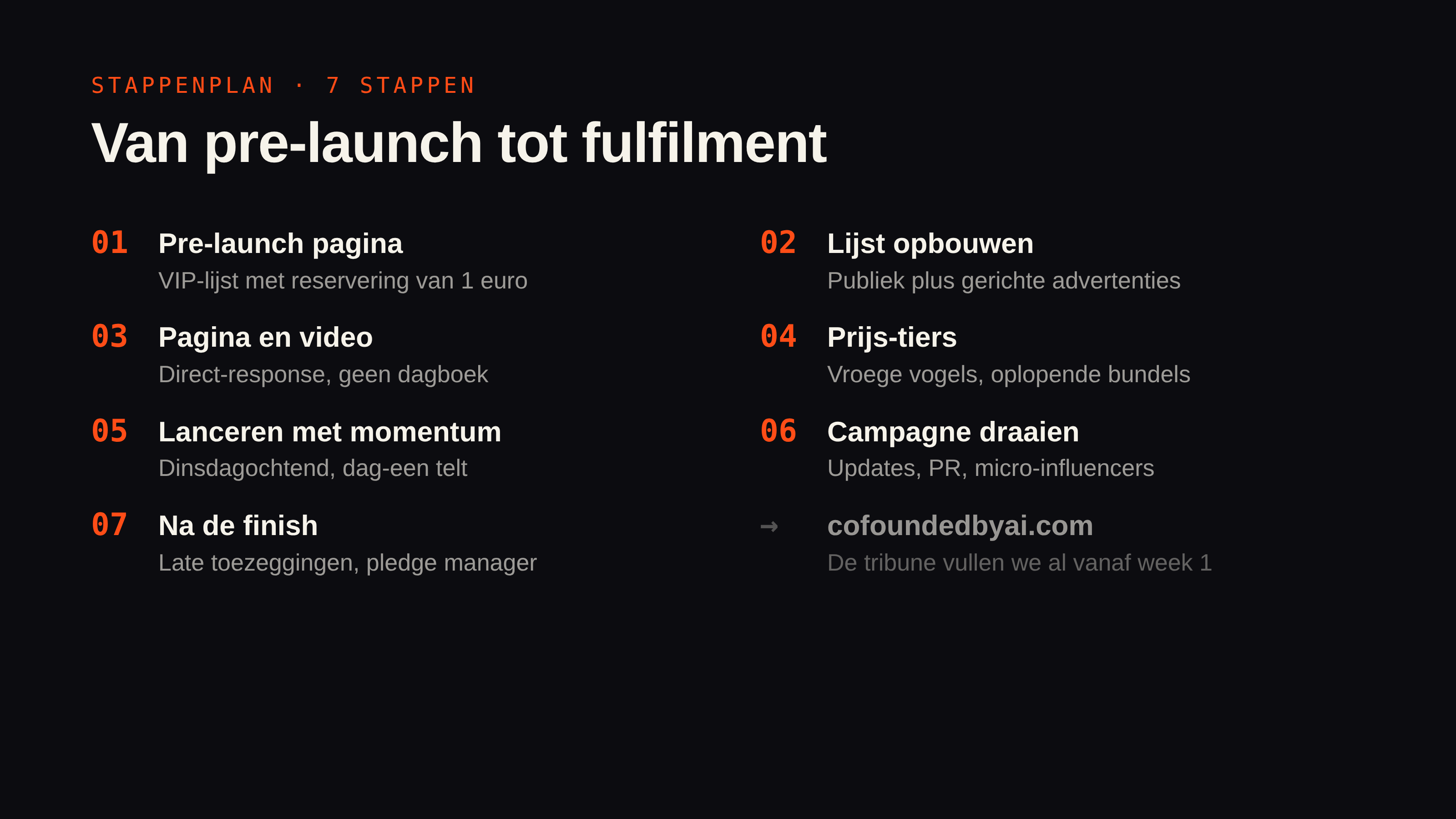
For anyone considering this route like we are, here's how it goes:
- Pre-launch page. Go live with a landing page and a VIP offer. A one-dollar reservation filters for serious buyers. Someone like that converts thirty times better than a plain email signup.
- Build the list. Feed that page with your audience and targeted ads. Track cost per reservation and scale what works.
- Page and video. Treat the campaign page as an ad, not a diary. Short headlines, images that show, a video that sells the promise in fifteen seconds.
- Price tiers. Work with early-bird discounts and bundles. Scarcity and a deadline drive conversions.
- Launch with momentum. Pick a Tuesday morning and send your list to the page. Day one sets the tone: 20 to 30% of your final number lands in those first 24 hours.
- Run the campaign. Feed updates, PR, and micro-influencers. A maker with 10,000 followers converts better than a big name.
- After the finish. Open late pledges and collect addresses via a pledge manager. That's where you calculate shipping and sell add-ons.
The week-seven observation
Most entrepreneurs find Kickstarter when the product is done, then start building an audience. That order isn't optimal. The Kickstarter platform rewards whoever built an email list months earlier. We've been building that list since week one, publicly, with every week log.
That makes the Kickstarter choice for minagi less a gamble and more a logical next step. Over the coming weeks we'll test whether the prototype is tangible enough for a real campaign video, and whether our readers convert to reservations. If not, we learn that early and cheap. If yes, our launch plan is already there.
The lesson for the digital professional: crowdfunding isn't fundraising after the fact, it's audience building beforehand. Don't reverse the order.