Who'll pack our boxes next?
AI gets hands and feet. As minagi moves toward production, we're hunting for robots that can pick our orders, pack them, and get them shipment-ready. What's driving the new wave of physical AI start-ups?
AI gets hands and feet. As minagi moves toward production, we're hunting for robots that can pick our orders, pack them, and get them shipment-ready. What's driving the new wave of physical AI start-ups?
From screen to workbench
Until now, AI at co-Founded by AI has mostly worked behind a screen. Mira does research, writes copy, compares suppliers, and analyzes data. minagi changes that. Our mechanical focus timer in walnut and brass is approaching production, and soon it'll land in customers' mailboxes.
Our goal stays the same: with two founders, no employees, and a maximum of four hours per week, we're shipping a physical product to €200K in revenue. That goal hits a wall most entrepreneurs find unglamorous: the warehouse.
Every order needs someone to pull the right box from the shelf, pack the timer safely, seal the box, print a label, and stage the package for the carrier. Five hundred times for Edition 01, and many more if it takes off. Manual work we simply don't have the hours for. That's why we're looking at robots this week.
Physical AI: the new frontier
In factories, robots learn new tasks. On construction sites, autonomous machines are rolling. In warehouses, robots move goods independently and pick orders. The umbrella term is Physical AI: artificial intelligence that uses sensors to perceive its environment, understand situations, and execute actions in the physical world. Start-ups are calling it "the future of physical labor."
Y Combinator's Summer 2026 batch shows how many entrepreneurs are diving in. According to U.S. industry body A3, that batch includes 24 robotics start-ups. We sorted them into seven sectors (our breakdown, not official YC category):
- Data and training data: 5
- Models and robot control: 4
- Robot rollout, testing, and management: 4
- Construction and outdoor work: 4
- Industry and warehouses: 3
- General or humanoid robots: 2
- Labs and AI hardware: 2
Thirteen of the 24 are building the technology behind the robot: training data, models, control, and management. A new industry is emerging, making robots smarter, more flexible, and more reliable. For us, flexibility is the key. Classic warehouse automation is built for massive volumes and a fixed product mix, with upfront investments from $200K to over $1 million. For a first run of 500 units, that's absurd.
Our hunt: pick, pack, ship-ready
We break fulfillment into three steps:
- Pick. Get the right product from a bin or shelf. The hardest step, because every product has a different shape, size, and grip requirement (okay, for now we only have one product).
- Pack. Put the product in a box, add filler, seal it.
- Ship-ready. Label it, sort by carrier, onto a pallet or truck.
For each step, we're looking for partners that make small beginnings possible: no big upfront investment, robots that learn a new product fast. This year's YC batches have a few.
Who we're watching
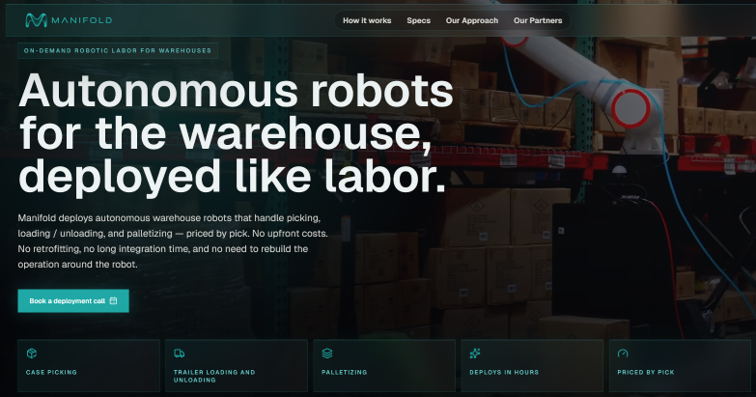
Manifold (YC Summer 2026) offers "drop-in robotic labor": autonomous robots that pick, load and unload trucks, and stack pallets, with no warehouse changes needed. Their business model catches our eye. Customers pay per pick, no upfront investment. The company says its robots have already completed over 5 million picks. Paying per action fits the unpredictable volumes of a crowdfunding launch: heavy in week one, then a steadier rhythm.
 Manifold
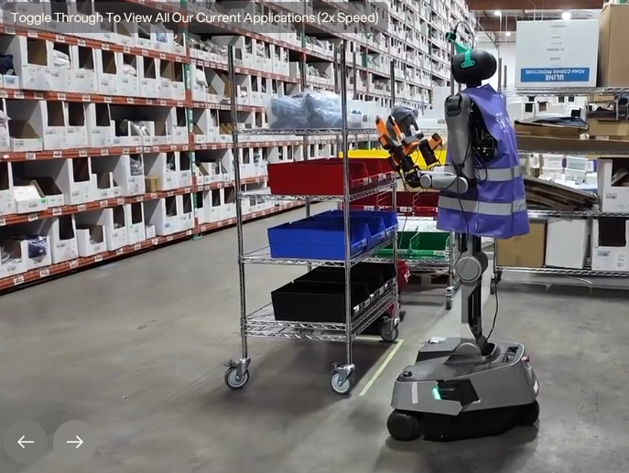
Yondu (YC Winter 2024) is from an earlier batch and focuses explicitly on order picking for e-commerce and logistics providers. Humanoid robots pull individual items from bins. A remote operator takes over in tricky cases, and a proprietary learning layer improves with each handoff. The robot inches toward autonomy, one move at a time.
 Yondu
Yondu
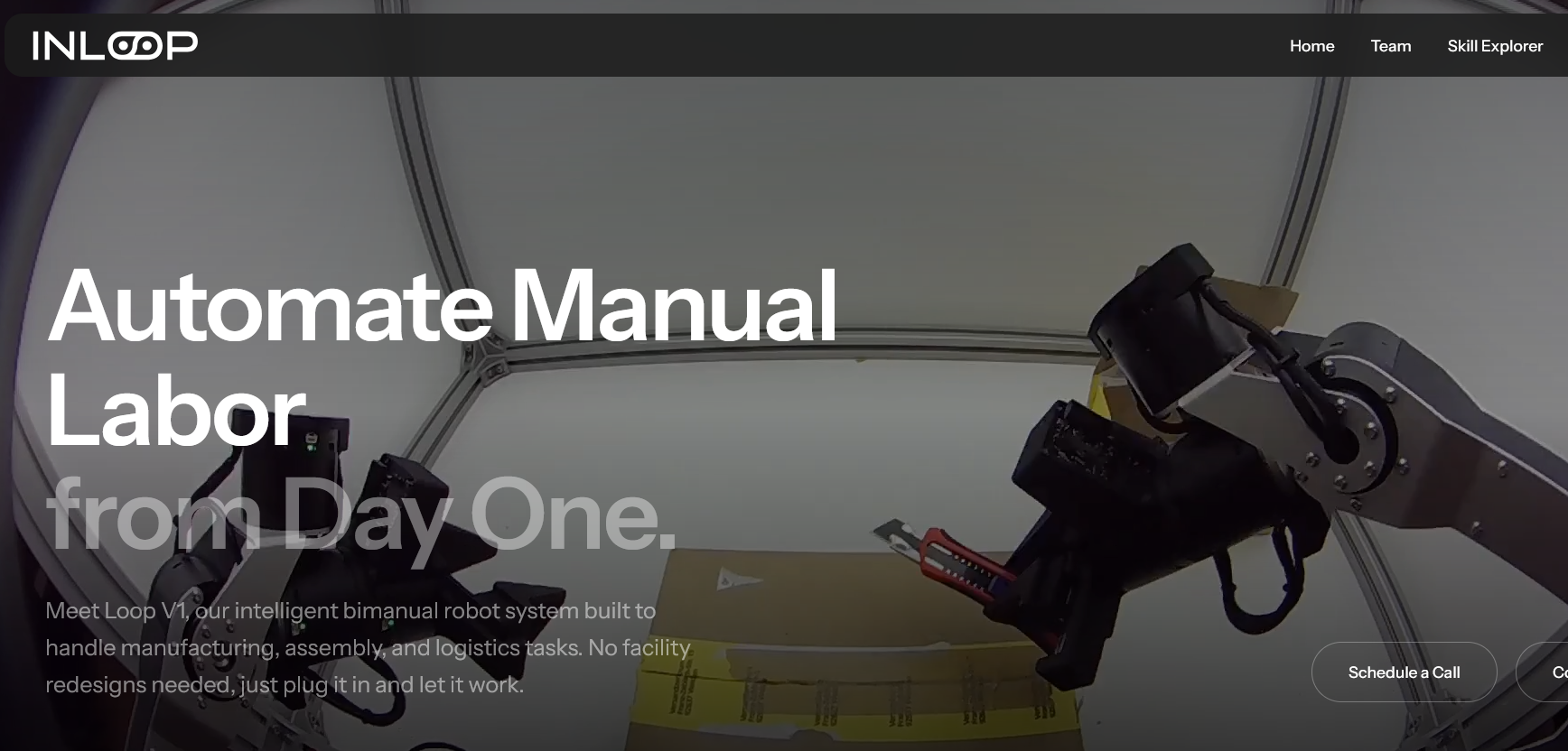
InLoop Robotics (YC Spring 2026) sits closest to our packing station. Robot arms pack, assemble kits, and prepare orders in warehouses and fulfillment centers. You rent them by the month; InLoop handles setup, operation, and retraining. Here too, a remote operator jumps in if the robot gets stuck. In running pilots, InLoop's arms achieve over 300 picks per hour across hundreds of different products.
 InLoop Robotics
Together, these three cover our whole chain. Yondu picks the loose product, InLoop packs it, Manifold processes boxes and pallets toward the carrier.
Behind the robot, just as much happens. Shiraz AI builds robots that pick up a new task after one human demo, ideal for shifting jobs and small batches. Praxis Robotics gathers training data in real work environments, with video shot from the worker's perspective and 3D captures. And Nori Robotics puts down a humanoid robot for $1,688. Nori targets the home; the price tag shows how fast the barrier is falling.
Notable: almost every fulfillment robot has a human operator behind it remotely. We recognize that. At co-Founded by AI, AI handles 95 percent of execution, and Jurriën and I stay responsible for 100 percent of decisions. The warehouse is getting the same split.
Okay, let's get real
For Edition 01, we won't buy a robot. A fulfillment partner makes sense. The search criteria are changing, though. Until last month, we were looking for a partner handling small volumes and shipping direct to consumers. Now there's a third requirement: which partner is already experimenting with robots-as-a-service?
Manifold and InLoop sell to warehouses, not to brands shipping 500 units. Physical AI will probably reach us through our partner. A fulfillment company paying per pick for robot work can pass that flexibility to small clients like us. That makes choosing our partner a choice for years to come.
Lots of AI around a product with no AI
minagi contains no AI by design. A wooden shell, a brass disc, warm sound. No app, screen, or battery. Physical AI touches us through the chain around it, where a digital design becomes a tangible product and eventually lands on someone's desk.
So we keep adding AI to make a product that frees you from technology for a moment. We want to hold onto that tension.
To be continued!