
Decision Criteria
What happens when entrepreneurs stop executing and only decide? AI does the work; the human limits themselves to making decisions.
Two seasoned digital entrepreneurs launch a radical experiment in co-Founded by AI. One product. No employees. One hard target: €200,000 in revenue in year one. Everything that's normally human work gets executed by AI. Market research, prototyping, marketing, sales, customer service. Production, warehousing, and fulfillment we outsource. The enterprise becomes a machine.
Through this column we keep the public posted on the choices we make, the progress of the experiment, and the bumps we hit along the way.
01 · We've begun
It's May 18, Van der Valk Hilversum. We're discussing our plans face-to-face for the first time. The energy is palpable immediately, and we run through a rough action list. Too much to list: name, brand guidelines, timeline, tech stack, product-selection criteria, commitments, and more. Ideas bubble up and we use Claude to road-test a few balloons.
02 · Iterate at breakneck speed
Over the following days, the WhatsApp messages (old school?) explode. Afternoon, evening, weekend, it doesn't matter. We share quick ideas and insights, then dive back in individually.
03 · Working on the decision criteria
Geert-Jan has already drawn up a list of criteria the new product needs to meet. Among them:
- Small physical product (low warehousing and shipping costs).
- Selling price €50–€150 incl. VAT (sufficient gross margin for marketing).
- No sizing or special fit (prevents returns).
- No certification required (CE, food, medical: always a hassle).
- Low service needs (AI must run support and online sales).
- No dominant brand player active (opportunity for a newcomer).
With ChatGPT we easily expand the list to 20 criteria. More of the same, just more detailed. Jurriën feeds the criteria into Claude. "I had Claude review the criteria, see document."
Claude: "The weight is missing on the demand side."
Oops. The customer. In agency-world, customer and customer journey always come first. Now we're only thinking about the best product to sell. How did we miss that? Is there even demand for the product? That's when AI adds even more valuable inputs:
- Demonstrable demand. Does search volume exist, an existing market?
- Repeat purchases. A one-off product means you're perpetually buying new customers via ads.
- Reachable target audience. Can you reach the buyer affordably?
- No race-to-the-bottom. Watch out for 50+ sellers on Amazon undercutting each other.
- Required seed capital. How much cash is tied up in inventory before you sell anything?
- Founder-fit. Is it interesting enough to you to talk about for years?
With Claude Co-work, Jurriën builds a dynamic scorecard where not every criterion carries equal weight. We plug in our candidate products and let AI rank them.
04 · The shape of an idea generator
Next step: the "AI IDEA GENERATOR". We're building a machine that produces product ideas. After Geert-Jan attended the E-commerce Network Event by RB Family Capital and Commerce Network, I realized we need more than a nice list of decision criteria.
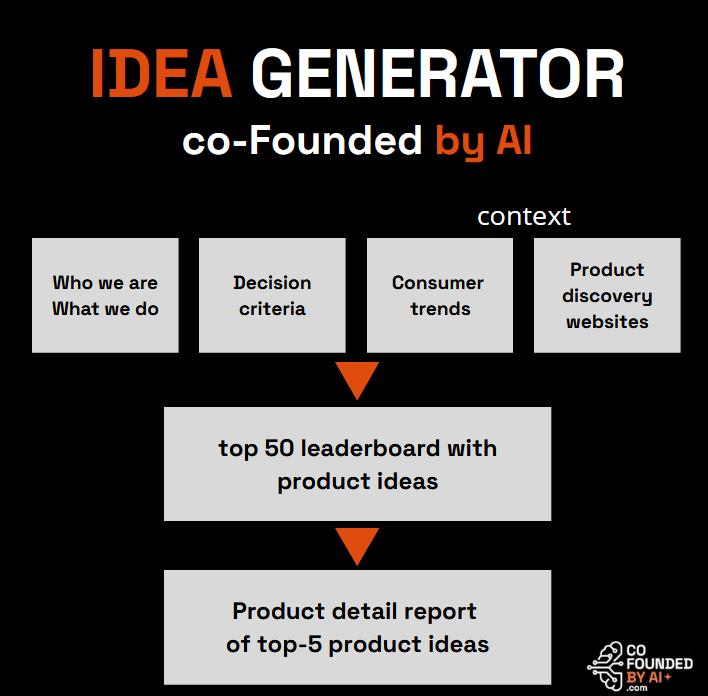
You also have to feed the system with context:
- What are current consumer trends?
- Which sites can you discover cool new products on (Kickstarter and similar)?
That's how the shape of the idea generator to be built emerges.