Governance model part 1
Governance in 4 layers and an agent passport
Eight AI agents work with us. They write, research, and help customers. This week we're fixing how we run that crew. The answer has four layers and a passport for each agent.
A crew needs direction
Jurriën Kerstholt and I are building a product company with AI colleagues. Before we know it, our team counts eight agents. One writes copy, another researches markets, a third answers questions on minagi's site. Every agent delivers work. Who decides what they know, what they do, and when we take the wheel back?
A customer sees a friendly answer in the chat. Behind it sits a chain of choices about knowledge, rules, rights, and accountability. We call that chain our governance model.
The model as a restaurant chain
A restaurant chain makes it concrete. The recipe book applies in every location: that's the Brain. The kitchen with house rules and checkout controls is the Harness. The cook is the language model. Stove, knives, and oven are the Tools. The passport is each cook's personnel file, with their task, authority, and the chef who directs them.
Four layers, humans decide. Founders at the top; below them, Company brain, Harness, LLM, and Tools. The agent passport runs through all layers. At the top sit Jurriën and I. We decide. Below follow the layers, from knowledge to tools.
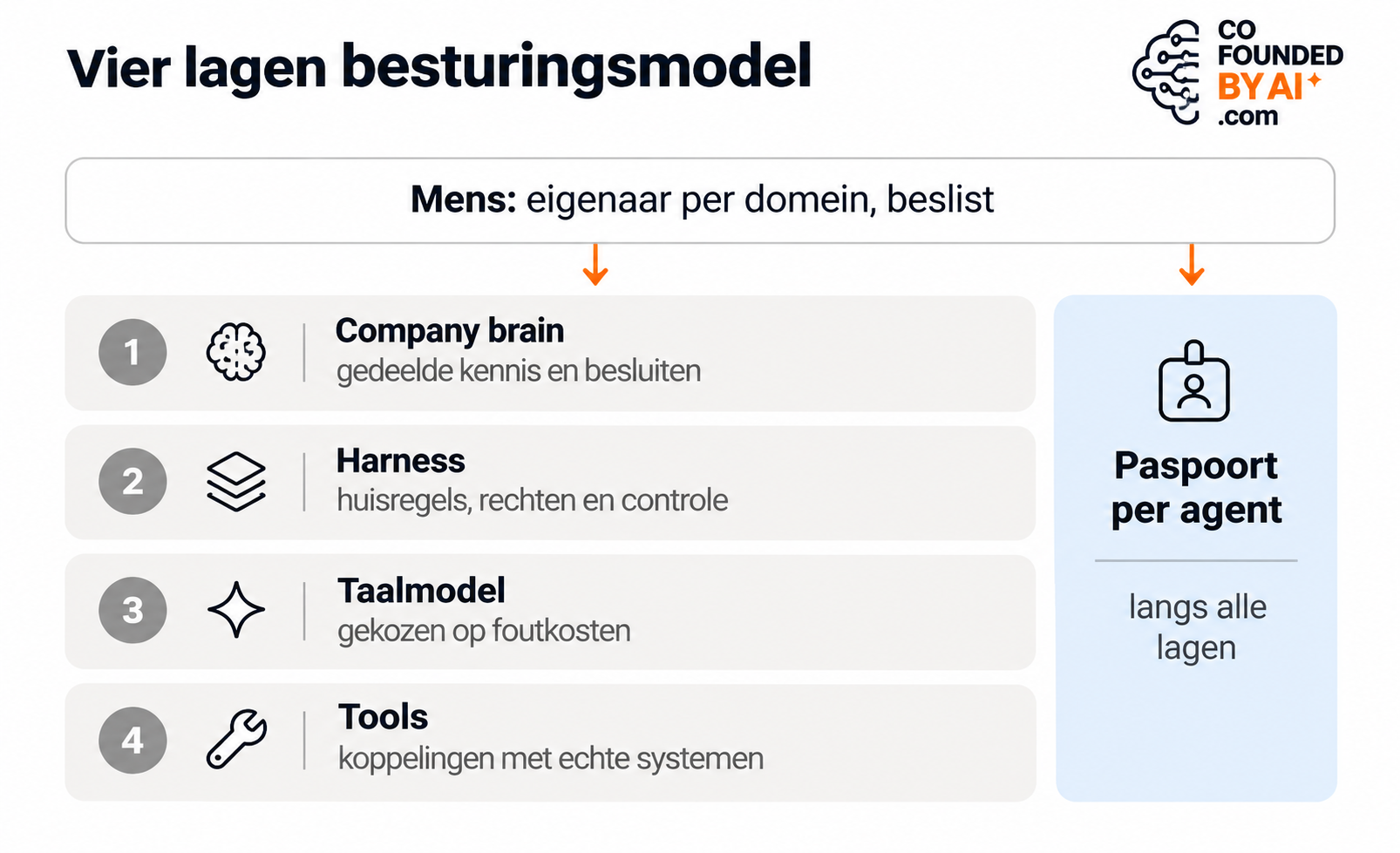 Visual: four-layer governance model.
Layer 1: the Brain
The Brain holds everything we decide, learn, and agree on: product data, house style, workflows, and skills. Every agent reads from the same source. That's how every answer aligns with our decisions. The Brain supplies knowledge; execution lives in the other layers.
For us, it's a folder in Drive full of markdown files. Those are plain text files with a few simple formatting marks, readable for humans and models alike. At the top sits decisions.md, our decision log. Every decision is in there with date and rationale, and this log beats every other file. An inbox catches new material. With brain.html we search the whole folder by keyword.
Layer 2: the Harness
Harness literally means harness. It's the software around a model. The Harness connects the model to the Brain, the tools, and our house rules. It manages the work loop, working memory, task progress, and controls, and it guards the boundaries in code. Its knowledge comes from the Brain.
An instruction file like AGENTS.md tells each agent what to read, what to write, and where. The same basic rules apply in every environment. We tune the technical setup to the model and task.
Layer 3: the language model
The language model understands, reasons, writes, and picks the next step. It's the most powerful component and also the easiest to replace. Every session starts blank. Memory and boundaries come from the other layers.
We run Claude, GPT, and Gemini side by side, split across three tiers: lite, workhorse, and top. The choice per agent follows error costs. What does a mistake from this agent cost? The higher that price, the heavier the model and the stricter the controls.
Layer 4: the Tools
Tools are an agent's hands. Through integrations, a model reads and writes in real systems: Drive, Gmail, MailerLite, and Higgsfield for image and video. Most integrations run via MCP, a fixed standard that gives agents access to a system's gateway. Each integration is a right. An agent gets exactly the integrations their task requires. Model and Harness decide when the tools spring into action.
The passport
The idea for the agent passport comes from Job van den Berg of ai.nl. The passport describes what runs. Per agent, you see at a glance the task, model, and hosting, the data sources, the rights, the owner, the error cost, the tier, and the domain. It also includes the moment when a human takes over and who the agent reports to. Each passport carries a number, a phase, and creation and last-modified dates.
Three ground rules keep the register current. An agent only runs in production with a passport. Anyone who changes the model, prompt, rights, or a data source must update the passport first. A review happens every quarter. The passport locks in the agreements; the Harness translates them into technical boundaries.
Mira at work
Mira answers questions on minagi's site. A visitor asks about the timer's material. The chat environment receives the question and pulls Mira's instructions and product knowledge. Her passport names the sources she consults and the actions that belong to her role.
 Visual: Mira directs our agents and handles customer service.
The Brain supplies the facts. The language model shapes them into a clear answer, in Mira's voice. The Harness gives her read rights on two knowledge files and access to MailerLite for email addresses. After twenty messages, the chat closes. That boundary sits in the software.
If a question falls outside her knowledge base, Mira points the way to the contact form. We take it from there. If the same question comes back, a proposal for an addition lands in our inbox. At Friday's review, we judge the proposals and process the best ones. The chat environment refreshes the knowledge base every ten minutes. The next conversation benefits instantly.
That's how every customer question makes the company smarter. Jurriën and I tend the source, review proposals, and set the operating space. The agent works within that frame. The more independently our AI colleagues work, the more our own craft as founders matters: organizing.
Four lessons for anyone deploying agents
Lock your business knowledge in one shared source and give each agent access to the part that fits their task. Give each agent a passport with task, model, data sources, rights, and owner, plus the moment when a human steps in. Enforce authority in software, with access rights, usage limits, and required approval. Treat recurring customer questions as a signal: expand the source and let the next customer gain.
Next week: the six steps to build this model and how it grows into an org chart with dozens of agents.