
Seven Renders of the Same Cube
Building a site for an object with no screen. The design comes from Claude Design, the code from Claude Code, the images from the GPT API. The hard part: making the same cube look consistent across seven different scenes.
Minagi has a name. Now it has a landing page: mi-nagi.com. The site isn't a shop, it's the storefront for a Kickstarter campaign we'll launch later: one page, bilingual, with an email field to sign up for the campaign. Minagi has no screen, no app, no notifications. The site reflects that absence. Which creates a real challenge. Conveying stillness without boring people is a different skill than selling a gadget with specs.

Design From Claude Design
We build the design system—colors, fonts, UI elements—with Claude Design. It outputs a package: a folder with tokens, components, and a separate Kickstarter UI kit. No loose moodboard for developers to interpret later. Colors, type scale, radii, shadows: all of it lives as code. This design system grounds every digital touchpoint and ensures consistency across the board.
Color choices matter deeply here. Walnut, brass, paper. Warm, tactile, analog, the exact materials of the product itself. The first version leans on a classical typeface. Round two gets tighter: Fraunces for headlines, Inter Tight for body text, JetBrains Mono for small technical details. And Shippori Mincho for that one character, 凪, the logotype that gets carved into the wood. A Japanese character deserves a Japanese font family. You settle these details upfront in the design system.
Building With Claude Code
Claude Code turns the package into a real site. Static, no heavy application for now, just an index.html with a stylesheet and some JavaScript. Open the folder, done. That suits a campaign page that needs to run for years with minimal maintenance.
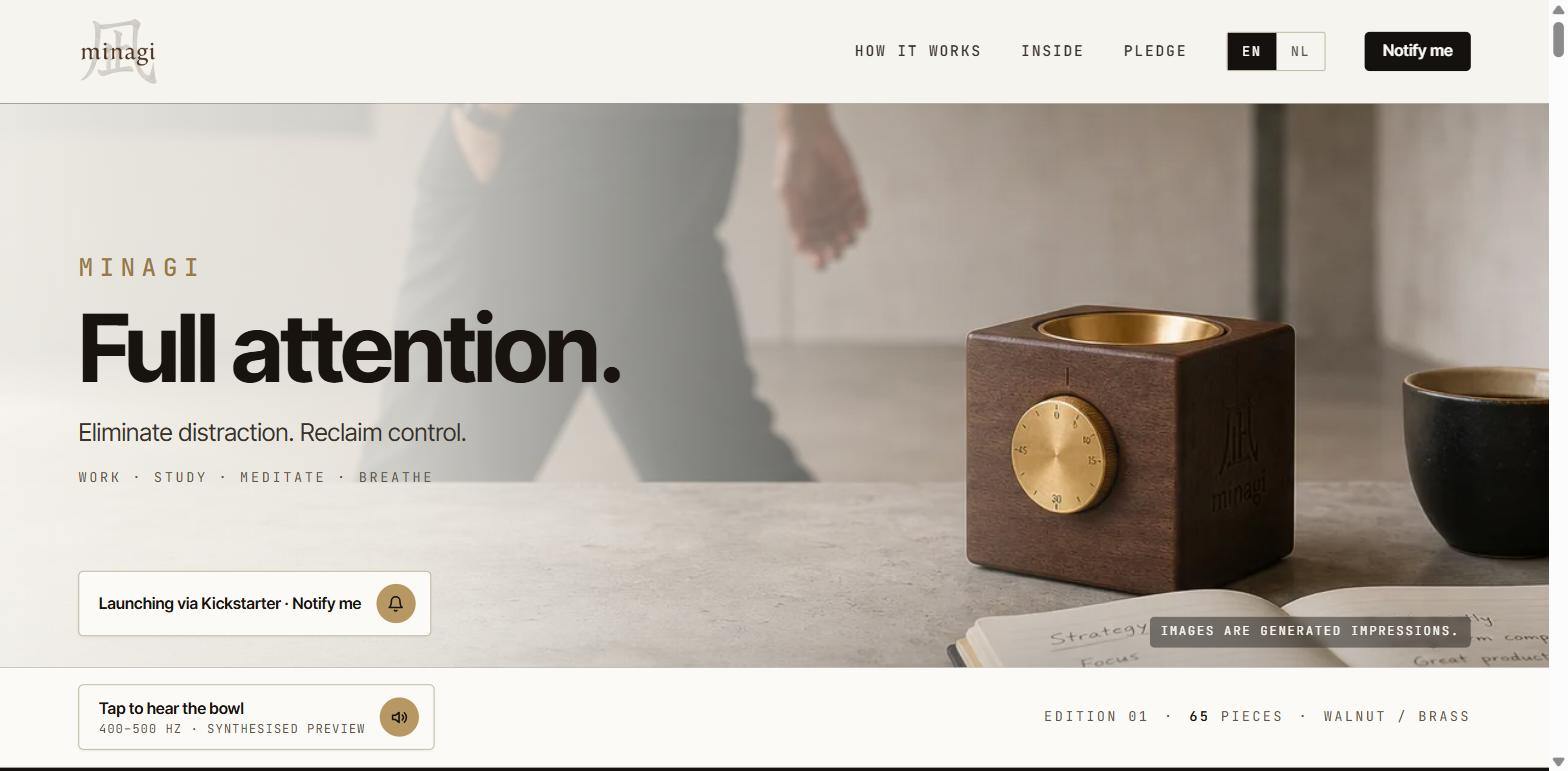
Making the site bilingual takes a detour that pays for itself. English is the base and fallback when JavaScript isn't available (matters for Google search). A script automatically translates the English text into Dutch, so one source feeds two languages. Update one version, both sites follow.
The cleverest trick is the sound. The tone scale on the site isn't an audio file. Web Audio technology synthesizes it live, around 456 Hz, one warm tone that sounds like the minagi timer going off. No download, no mp3, no load time. The site does acoustically what the product does mechanically: it does the minimum, and does it well.
The Real Work: The Images
We don't have a photo studio yet, the product exists only as a digital prototype for now. The images come from the GPT-images-2.0 API. Seven scenes, the same walnut cube on seven different desks: a designer, a student, a maker, someone working from home. On paper, that's seven prompts. In practice, it's the most complex process so far.
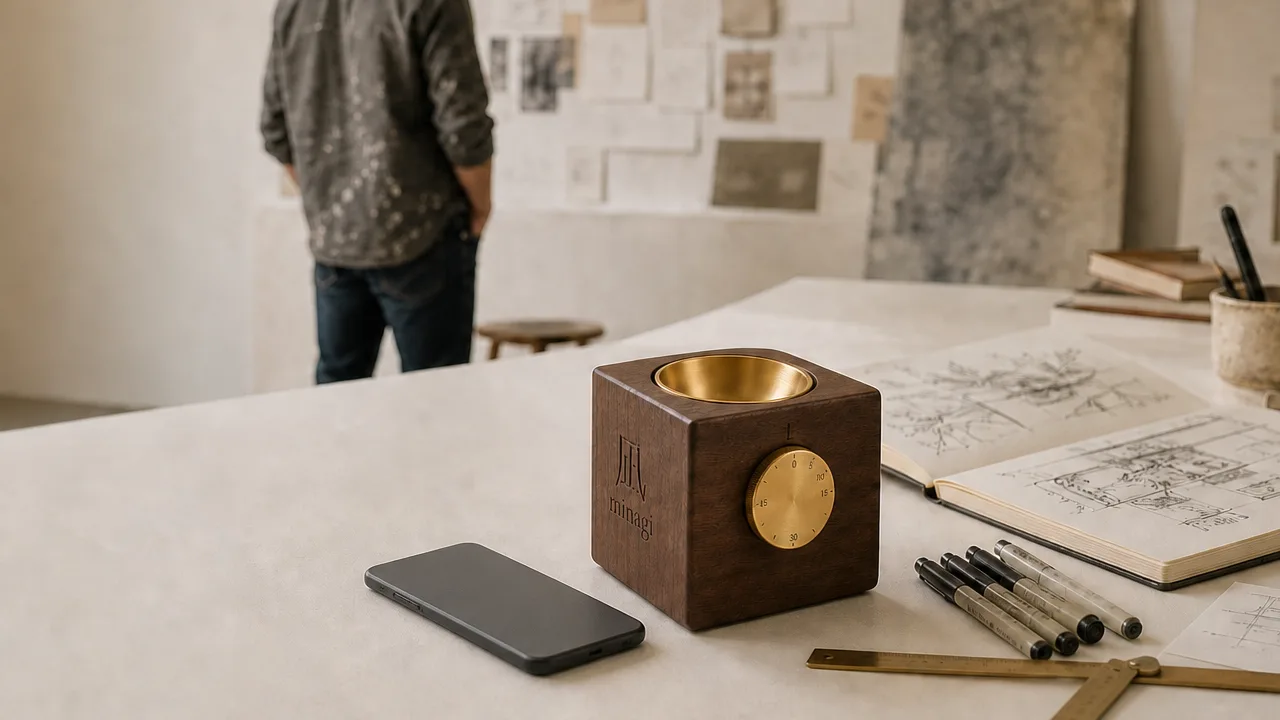
Every render draws the cube differently. Deeply annoying. One pass, four ridges on the brass disc. Next pass, six. The wood grain rotates a quarter turn. The soundscape shifts a shade toward gold. For a single image, no one cares. For seven images sitting side by side in a carousel as one set, every difference stands out. The cube looks like a family with variants, when the product is one thing.
Seven Times the Same Cube
That's the wall generative images hit today. The model learns a style, not an instance. Ask twice for the same object, you get two interpretations, not a copy. For a brand built on one exact object, that's a real, annoying problem.
The fix is in assembly, not a fresh render. We create one perfect render of the minagi and feed it as a reference to the API. The API generates the desired scene image and places the minagi object in it. Instead of re-rendering the minagi from scratch each time. That gets us the consistent, reproducible result we need. Another lesson learned.
What This Reveals
AI delivered the design, the code, and the images. Three disciplines, three tools, one afternoon each. Plus a long tail of work getting the photo scenes right. Humans deliver consistency. The model generates direction and volume, but someone with an eye for detail guards the continuity across seven frames. That's the split this whole experiment exposes: the machine makes plenty, humans hold it together. Minagi strips technique out of the product. The site behind it, mi-nagi.com, is loaded with technique to show that simplicity convincingly.