
Playing with LLMs
We're putting multiple language models to work to generate product ideas for us
The day after Whitsunday, we meet up again at a Van der Valk, this time in Breukelen. We're excited. Can't wait to get started together. It's also great to see each other in person, away from all the messages we exchange almost hourly (until 11 p.m.).
01 · Product ideas on demand
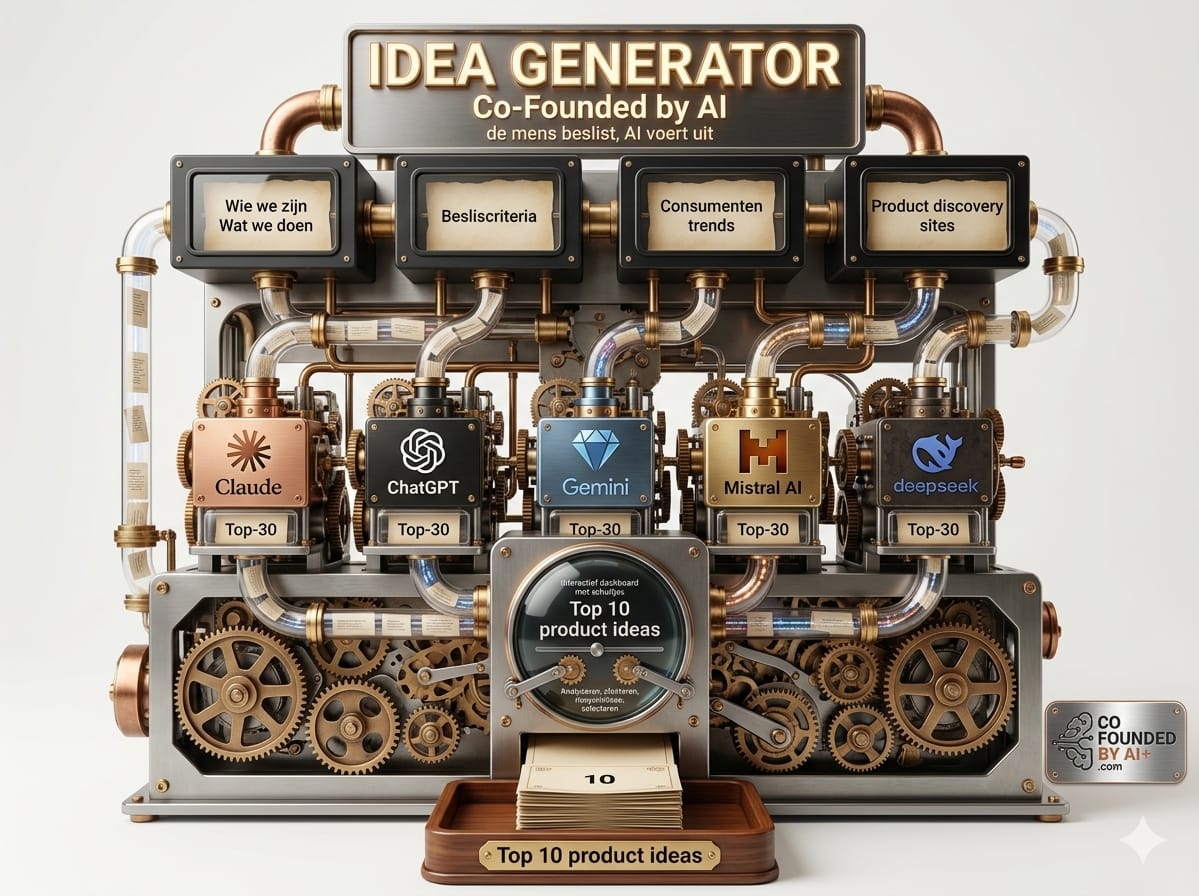
We're putting multiple language models to work to generate product ideas for us. First, we need to enrich our 20+ decision criteria. With context, that is.
It seems logical to us to add current consumer trends as context. And a number of websites where you can discover new products (product discovery sites). Think Kickstarter, Indiegogo, and Amazon Movers and Shakers.
It's fantastic, of course, to unleash the decision criteria plus context on multiple LLMs. What does Deepseek come up with? Is the European Mistral strong enough to produce a serious top 30 product list? Jurriën gets to work with Gemini and Claude. Geert-Jan takes on ChatGPT, DeepSeek, and Mistral. What stands out is that many product ideas come from the direction of calm tech, biohacking, and longevity. It's clear that multiple consumer trends are pointing here.
02 · Interactive questioning
The prompt we use is fairly general. We do ask the LLM to use interactive questions to hone in on which products are interesting for us and which aren't. ChatGPT comes back with 30 questions; we lose our minds over it.
Gemini, Claude, and ChatGPT quickly come back with neat product suggestion lists. Well organized, with descriptions and clear links to the trends they tap into. And how each product scores against our criteria.
03 · Ashwagandha and beyond
Deepseek does the job, but also comes back with unusual and sometimes funny products. "Ashwagandha gummies," "premium fidget cubes"... have we gotten so old that we've missed these trends? Or do we need to book a trip to China so we bump into these products in real life?
 Image: Ashwagandha gummies, Deepseek's top product pick
04 · How the process works
The process we follow looks like this: We feed a prompt into an LLM with a few attachments:
- Who we are and what we do
- Our decision criteria
- A number of documents with context (consumer trends and product discovery sites).
Here's what that looks like.
05 · EMERCE E-commerce Live
Thursday, May 28, is another Emerce E-commerce Live event. Geert-Jan gets to host the day and moderates several interesting sessions, including one on "AI in e-commerce: hype or necessity." With Maurice Lancee (Night Rain) and Michael Tesselaar (Vibeday). The panel surfaces several interesting takeaways:
Start with your product range. AI helps enrich product data and helps customers choose better, compare, and get answers.
Experiment broadly, but strategically. Test AI in customer service, marketing, development, and procurement, but always with a concrete use case and learning goal.
Improve customer experience. The biggest opportunity lies in better service, more relevant recommendations, and smoother support throughout the purchase process.
Make employees more productive. AI helps teams analyze faster, create content, handle customer questions, and improve product data.
Choose models and data carefully. Not everything requires the priciest model. Pay close attention to what customer and business data you share.
Set clear ground rules. A practical AI protocol prevents risks and makes experimenting easier.
Organize AI expertise centrally. A small dedicated AI team can support the entire organization.
Stay flexible. Tools change fast. Test multiple solutions, avoid lock-in, and share successes internally.
During the day, Geert-Jan meets with Gijs Vroom, publisher and owner of EMERCE. He's immediately enthusiastic. We can pitch a column every two weeks. There may also be room on Emerce TV, provided a slot opens up (a "stopper"). Gijs gives the following tips: submit your column on a fixed day, don't write too much about AI (😊). Write it like a page-turner; it should read like a boys' adventure. We're on it. As Geert-Jan walks out, Gijs throws one more thing out: "Can I get a stake?" He's a real entrepreneur. We'll think about it. Maybe 2.5% of net profits after year one is a fair offer?
06 · Social signals
During one of the breaks at the event, Geert-Jan connects with Maurice Stam, co-founder of Vibeday. He walks Maurice through the plan and gets brilliant feedback: "You should also factor in social signals to your research." In other words, visible signals from social channels showing where people are paying attention, talking about, responding to, or excited about.
This insight quickly reaches Jurrien, who gets to work with Claude: "Can you figure out which products are trending on social media (including TikTok)? Because this is an interesting indicator.
Results of the scan: "Key finding first: Sleepmaxxing is the hot trend on TikTok in 2026 (70M+ views on sleep-optimization alone), which strongly validates your longlist top. But there are 4 candidates I'm missing from your longlist that are now going viral within your criteria..."
 The TikTok trend right now: Sleepmaxxing
This is interesting.
Claude also tells us which products we should NOT include, even though they're currently going viral on social media: We don't want CE certification (anything with a plug), no cosmetics, and no medical claims (like the "migraine cooling caps"). Additionally, there are "hot products" that are simply too large (a knockout criterion for us, because that creates too much hassle with storage and shipping).
An important insight Claude gives us: TikTok conversion is strongest in the €15-€30 price range. Our target price of €50-150 is clearly above this sweet spot. TikTok seems to be mainly a channel for impulse buying. We won't profit directly from that. Conversion won't come directly via TikTok, but we can use the channel to generate attention. To be continued.
Geert-Jan Smits & Jurriën Kerstholt - Founders co-Founded by AI