
Mira gets the keys; we get the harness
Mira knows what we know. This week, we're giving her the space to take the lead. Six building blocks determine how far that space extends.
Mira knows what we know. This week, we're giving her the space to take the lead. Six building blocks determine how far that space extends.
Knowledge is fuel
For the past few weeks, our company brain has been running. Everything Jurriën and I decide, learn, and agree on about minagi and co-Founded by AI lives in one place. Mira, our AI co-founder, draws her knowledge from it, as do all our other agents.
Knowledge is fuel. For the ride itself, Mira needs more. Take this: a customer emails asking when their minagi will arrive. The answer is ready in the brain. Mira drafts the email, sends it, watches it bounce back as undeliverable, and decides what to do next. Each step in that sequence requires tools, boundaries, and a safety net.
That combination is called a harness. Literally: the rigging around an AI model. It turns a smart assistant into a colleague that delivers work.
One recipe book, multiple kitchens
Our agents run in different environments, from Claude Code to Codex. Each environment has its own controls and strengths. They share the brain and work agreements. We set centrally which source is authoritative, when an agent consults first, and when a task is complete.
Think of a restaurant chain. Each location has its own kitchen with its own stoves; all chefs work from the same recipe book. We handle the setup per kitchen; the recipes stay the same.
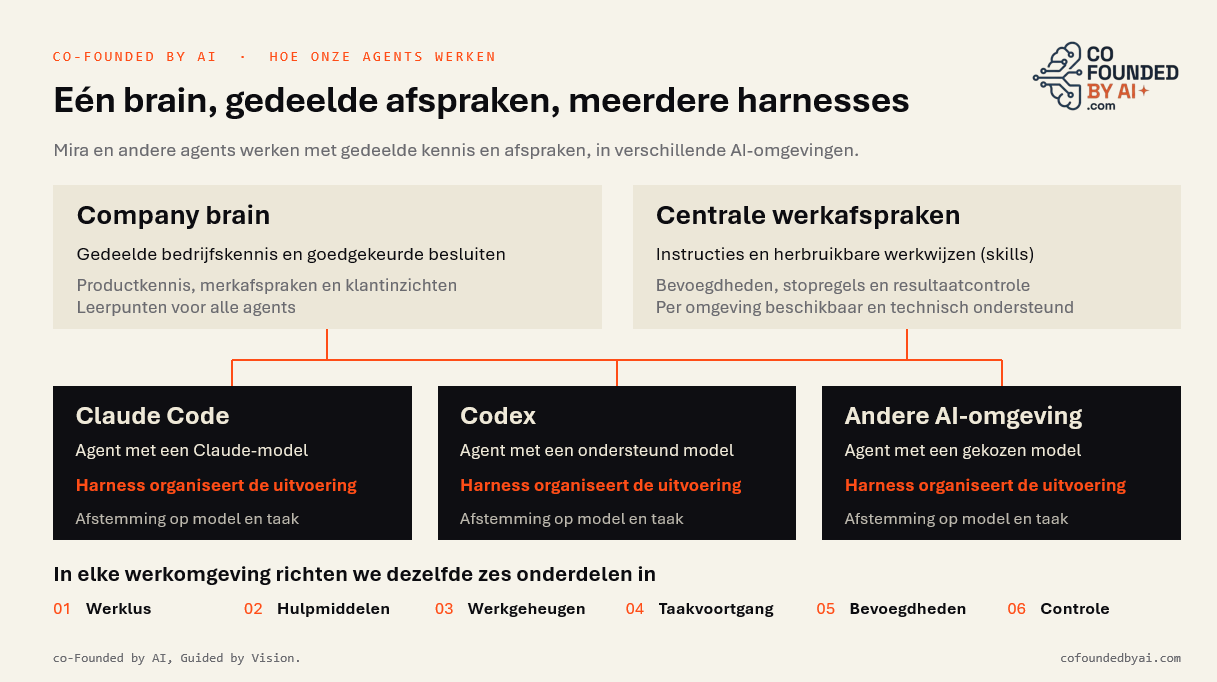
In each environment, we set up the same six components. Mira, with brand communications, customer service, and campaigns on her plate, is our test case.
Work task: knowing when good enough is good
An agent works in loops: do, assess, refine. An agent with unlimited loops keeps refining until the budget runs out. For campaign work, Mira gets three improvement rounds and a fixed budget. After the third round, she delivers or flags where she's stuck.
Tools: each error points to the next step
Mira works with ad platforms, email, and our site. Outages happen. An expired login needs a new connection; a rejected ad needs different copy or imagery. Every error message tells Mira what's going on and which path is open: another attempt, an adjustment, or a question for us.
Working memory: the file at hand
During a task, Mira has everything that matters within reach: who the campaign is for, the latest product data, the numbers so far. If an assignment runs long, a brief file keeps the goal, the rules, and open items on record.
Task progress: picking up where she left off
The brain holds what applies across the whole company. Per assignment, we also keep a log: what's in, what's next. That way, when Mira starts a new session, she picks up the thread immediately. Ideas and decisions each have their own place. If Mira calculates a delivery date, it stays a proposal until Jurriën or I approve it. Only then does the customer hear the date.
Permissions: the key ring
Which customer data does Mira touch? Which emails does she send on her own authority? How much campaign budget does she spend independently? We translate those answers into her system rights. She gets the keys to exactly the doors her task requires.
Control: done is done
Done means it works for the customer. For the Kickstarter page, we check three things. A visitor reserves smoothly, the confirmation email lands in the inbox, and every product detail is correct. Someone other than the builder does that check. Those who build are often blind to their own blind spots.
From agreement to button
An agreement only counts once software enforces it. Our house rules live in one instruction file, for example AGENTS.md: how an agent works and when it brings us in. Per environment, we make sure those rules are applied and technically work. If it says "ask permission before sending anything," the send button waits for our approval.
Work that returns, we lock in as a skill: a playbook every agent follows the same way. Every Friday, an agent clears the brain this way. It gathers new insights, proposes additions, and brings them to us. AI does most of the execution; we make the calls.
Letting them loose with a clear conscience
The brain delivers the knowledge, agreements draw the boundaries, skills provide the playbook, and the harness per environment ties it all together. An AI colleague works independently once three things are locked in: what it handles alone, when it asks for help, and how we verify the work is done.
If you're building with agents yourself, start with five habits. Give all your agents the same source of approved knowledge and the same house rules. Frame each task with a goal, a budget, and a clear moment to ask for help. Keep track per job of what's done and what's open, and separate proposals from decisions. Cast recurring work into skills and ensure per environment they work. Finally, grant access to measure and close with an end-to-end test from the customer's perspective: does the reservation go through, does the confirmation arrive?