
In search of a designer
01 · AI can do a lot, but a singing bowl demands a human
At co-Founded by AI, we're testing a deceptively simple question with major implications: can you build a product company where AI handles almost all the execution? Our goal is clear. A physical product, no employees, maximum four hours per founder per week, and €200,000 in revenue in year one. Jurriën and I set direction, make calls, and break ties. AI does the rest. Or so the plan went.
Over the past few weeks, we've been working on The Dual, later renamed minagi. A premium focus timer, fully mechanical, with beautiful materials and a singing bowl as the standout feature. Think walnut, brass, and leather. No plastic gadget that beeps. An object you'd actually want on your desk, dining table, or nightstand. A product that blends a productivity tool, a ritual, and a design object.
AI tackles the early stages with impressive results. Market research, concept selection, positioning, target audiences, pricing direction, competitive analysis: within weeks, we had more material than an average product team could deliver in a week.
But here's where we hit a wall: "design for manufacturing." Not the thinking, writing, or research stage. The bar there is already high. The wall we hit is tangibility. Material feel. The question of how hard a hammer strikes a singing bowl without sounding cheap. The millimeter between elegant and rickety. Understanding 3D space.
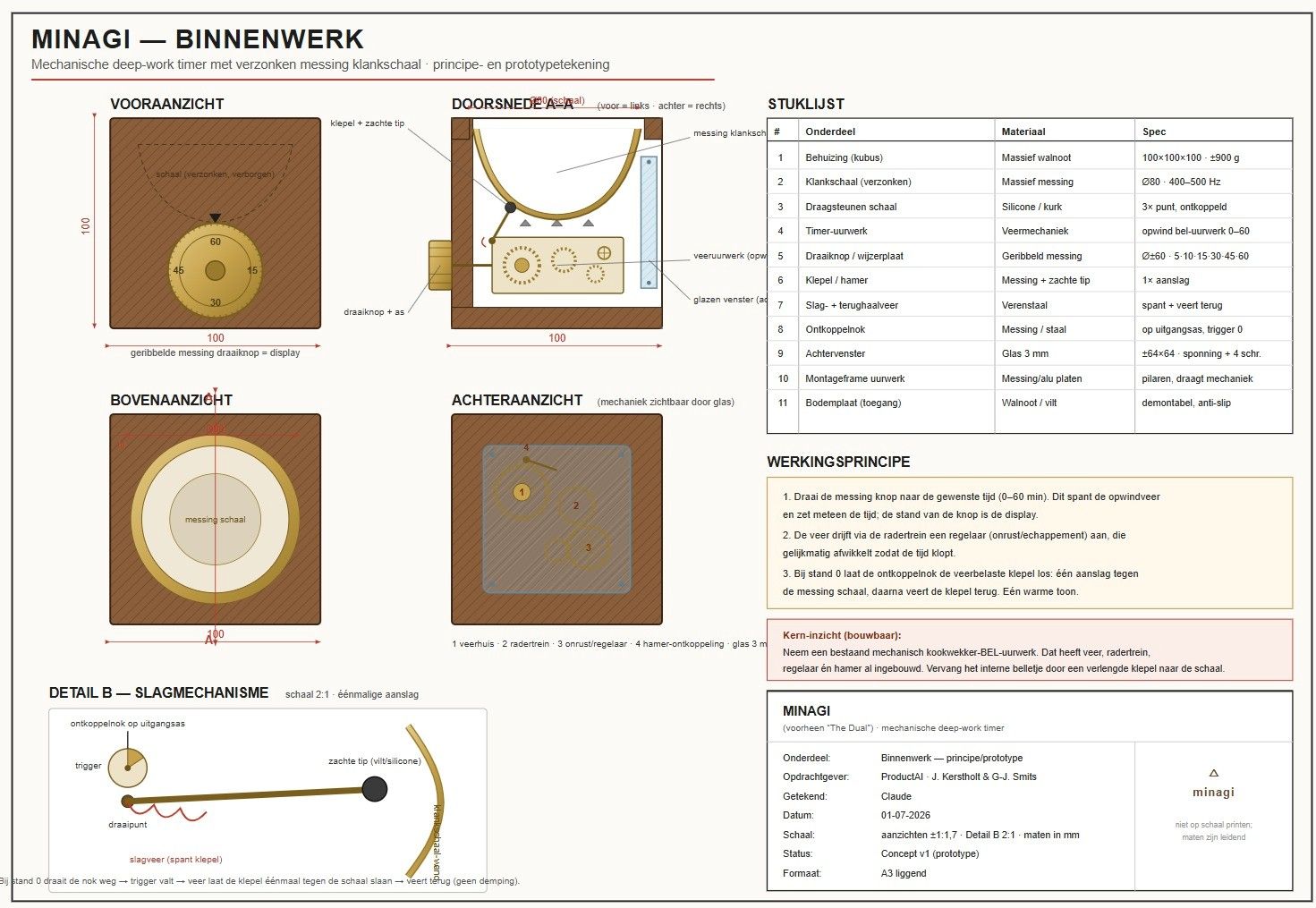 Image: prototype sketch generated by Claude
Here's the insight from this phase: AI can go far with language, analysis, and product logic. But it stumbles the moment a good idea needs to become a physical object. We asked for clear design direction with renders, side views, CMF specs, a robust operating mechanism, the selection of a timer movement, a design for the singing bowl and striker, plus STEP and native CAD files. On paper, it sounded convincing. In practice, it stayed stuck in lovely descriptions and clever suggestions, without the spatial precision a manufacturer needs. The housing, mechanics, materials, and movement don't grip each other tightly enough. That's not a minor glitch; it's a crucial finding. Today's AI models are strong with language and patterns, but not yet with physical manufacturability, tolerances, assembly sequence, and three-dimensional spatial reasoning.
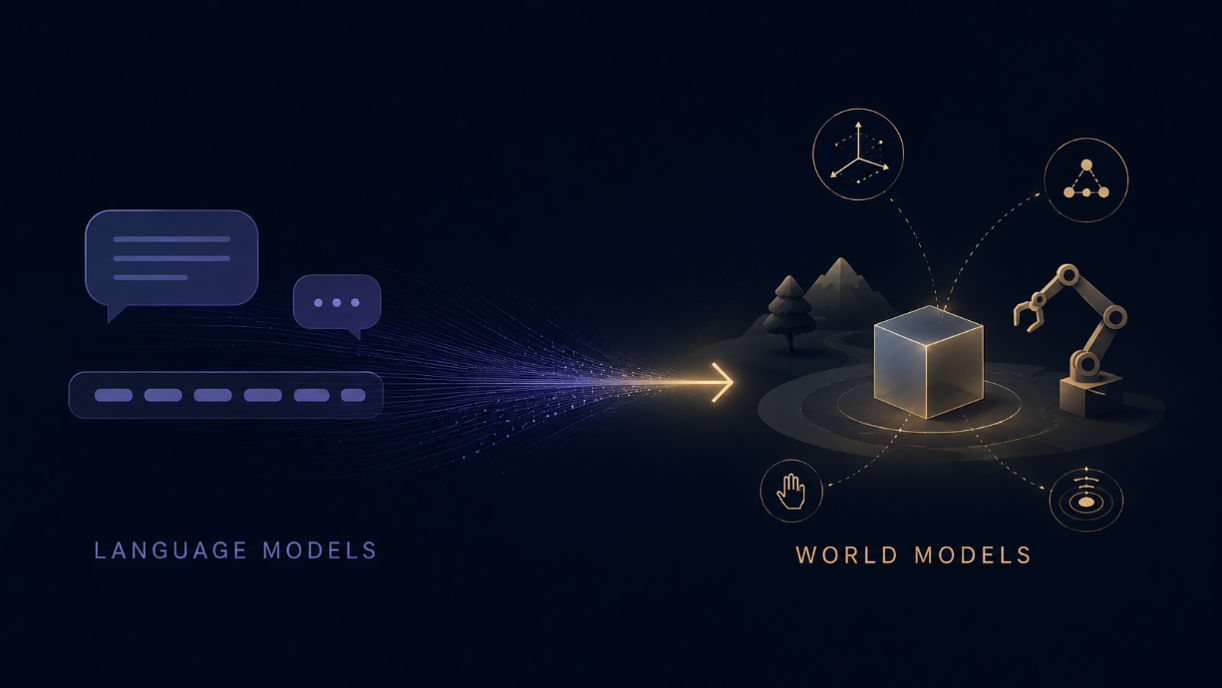 Image: From language models to world models
That's precisely where "world models" come in: AI systems that don't just describe the physical world but understand it. And that's where companies like General Intuition see an opening, building that spatial, almost human product intuition. For our experiment, this is gold. Product design still demands human direction, technical sharpness, and specialist design expertise. Until then, AI is a brilliant sparring partner, but not yet an industrial designer of a physical product like minagi.
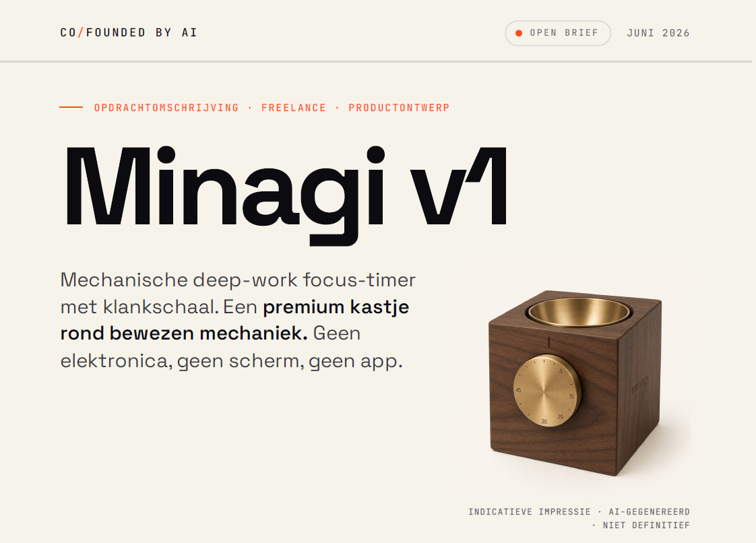 Image: Design brief for minagi
02 · Report 1
If AI can't yet design alone, we'll ask it to find an industrial designer who can build out minagi. Someone who handles design, engineering, DFM (design for manufacturing), and production files. From a beautiful AI concept to a manufacturable product. That still requires human involvement. Craft, creativity, and knowledge of materials and mechanics.
The search results looked professional: a twelve-page report, a ready-to-RFP brief, and ten design studios across three price brackets.
On closer inspection: things went badly wrong.
AI thought like a consultant with unlimited budget. Names like LAYER, fuseproject, Bould, Blond, Morrama, and Industrial Facility came through. Beautiful studios. Strong track records. Relevant work. Just not for us. Cost estimates ranged from €50,000 well above €150,000. For an experiment where we're thinking €5,000 to €10,000 for design costs, it feels like asking for a bike and having AI come back with a Bentley.
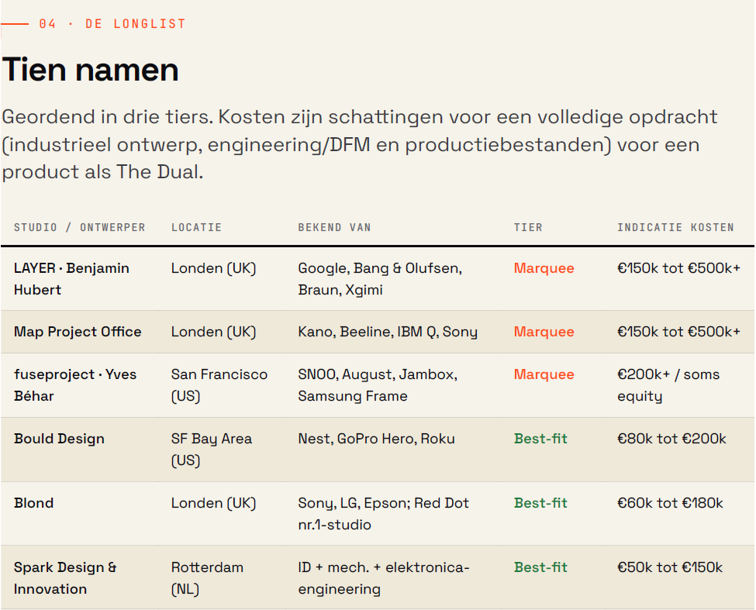 Image: The longlist of beautiful design studios, but not the fit for us
03 · Product adjustments?
That sounds like a mistake, and it was. But the real error, of course, was ours. We never gave AI a budget. AI optimizes for quality, reputation, and completeness. Not for feasibility. That's exactly what organizations are experiencing now. They ask AI for a solution, get an impressive answer, then discover the context was missing. AI thinks fast, but not automatically lean, practical, or entrepreneurial.
The second round yielded better insight. We don't need to build a smart timer with e-ink, a battery, USB-C, a circuit board, and firmware. That immediately pushes the product toward electronics development. Expensive, slow, and risky. The distinctive part of minagi sits in its mechanical character: a wound focus timer that strikes a brass singing bowl at the end. Proven technology, beautiful ritual, lower complexity.
That changes the brief. Not: design a full electronic consumer product. Instead: design a premium mechanical focus timer around existing technology, with a working "striker mechanism" for the singing bowl. That doesn't need a world-class studio. It needs a freelance industrial designer, supplemented by a maker, a mechanics enthusiast, or a watchmaking tinkerer who understands and can test hammers, strike points, resonance, and materials.
Takeaway 1: always give AI a budget, timeline, target audience, and quality bar before asking for advice.
Takeaway 2: shrink the scope to the element that creates differentiation and value.
Takeaway 3: use AI for research and briefing, but bring in experts where material, mechanics, and experience count.
Takeaway 4: treat every AI output as a first concept, never as a final decision.